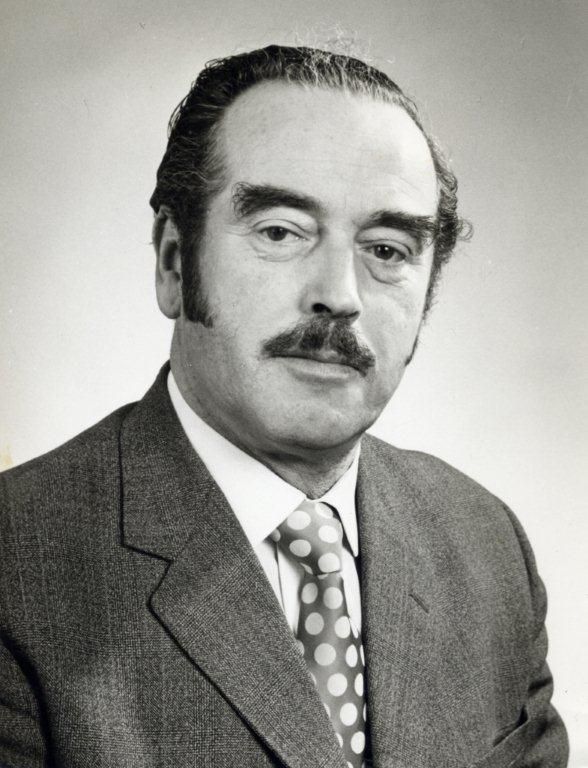
Ron Wisson's Memories..
"I first met Ted Saywell in October 1942 at 15 Operational Training Unit, Harwell, Berkshire. There were about 100 or so newly trained and promoted Sergeant aircrew milling around in a hangar, and we were instructed to form up into crews !!! Ted ended up with:
Ernie Moore - Navigator,
Frank Whittaker - Bomb Aimer,
Frank Ward - Rear Gunner,
Ginger Hughes - Air Gunner, and
myself - Ron Wisson as Wireless Operator.
At Harwell we trained together as a crew doing circuits and landings as well cross country flights and ground school. Total flying time 82 hours and 45 minutes as a crew, although we all had our initial flying training hours. In December 1942 we were posted to 1652 Heavy Conversion Unit at Pocklington near York, Yorkshire, where we were introduced to the Halifax Mk2 which semed a massive aircraft compared with the Wellington.
We also aquired another crew member, Joe Marsh, Flight Engineer.
On completion of the conversation to the Halifax a fantastic 23 hours and 45 minutes training we were transfered to 102 Squadron on the same airfield and started operational flying. We did 14 operational flights over Germany as you will see from the logbook extracts. We had some very narrow escapes from being shot down, but were gaining in experience and confidence. Most crews were shot down during their first 5 operational flights largely due to lack of training and experience.
We were selected as an experienced crew to join the Pathfinder Group, and went to the PFF Training Unit at Upwood where we did a magnificent 7 hours and 50 minutes flying learning new techniques and equipment. Our next posting was to 35 Squadron PFF at Graveley, near Cambridge.
On the 13th July our target was Aachen, and we carried a normal bomb load of HE incendiary bombs, as we were designated as a main force A/C on this our first 35 SQDN operation. The marker aircraft used to drop coloured flares onto the ground to mark the aiming point for the main force which followed. Back up aircraft dropped more flares onto the target indicator flares and also incendiary bombs to start fires which were also used as aiming points. There a several books which have written which describe these techniques in detail, the best is probably Pathfinder written by Donald Bennet who was C in C of the PFF Command.
On the fateful night we took after dark from Graveley and headed for Germany, the flight was uneventful, with everybody keeping a good look out. We saw one or two searchlights and AA fire in the distance, we did not see the ground as there was partial cloud cover. About 20 or 30 miles from the target the navigator gave Ted a small course alteration towards the target which had not yet been illuminated by the marker aircraft. We were about 2 or 3 miles ahead of the main stream of the force which consisted of about 300 aircraft, as far as I remember.
The rear gunner called on the intercom enemy aircraft in sight, stand by to corkscrew, this was the basic evasion, to fly in a corkscrew motion, and once started the German night fighter would normally sheer off and look for another target which he could attack before he was sighted. We had experienced this a couple times before on previous ops.
As we started to corkscrew our gunners started firing, and we were hit by the German firing, which according to the rear gunner was a Messerschmitt 110. None of our crew had been hit, but our starboard wing and inner engine was hit and became a massive fire within seconds. The aircraft rapidly filled with smoke.
Ted gave the order to bail out, it was obvious that there was nothing the crew could about the fire. I moved forward to the navigator's position, where Ernie had the floor escape hatch open, and was putting his parachute on. He shouted to me to get out which I did, feet first through the hatch. I had to push myself away from the aircraft. Shortly afterwards my parachute opened, though I do not remember pulling the release handle. I was swinging backwards and forwards, but this stopped after a few minutes and I was able to look around. I could not see the burning aircraft from which I had jumped, but then went into a bank of cloud which reduced visibilty completely.
I had expected to see the aircraft above me as I am sure that Ted would have held it straight and level while the crew got out. His chances would have been much less as he would have been the last to leave the aircraft. I think that the aircraft must have gone into a spin or exploded killing all the crew instantly.
The ME 110 which attacked us had better armament than RAF bombers which had only .303 calibre machine guns in the rear and upper turrets. The German night fighters had 20mm cannons which were twice as big and had twice the range. So our chances were pretty poor. The night fighters would approach from below and behind where they could not be seen. The bomber was an easy target from that type of attack.
The area where were shot down was I believe approxinately 20 to 30 miles west of Munchen Gladbach and about 30 miles north of Aachen.
I seemed to be falling through cloud for quite a long time, and eventually came out and could see one or two glimmers of light on the ground, it was very dark. In the distance probably several miles away there was a large fire burning. I feel sure that it was our aircraft.
I hit the ground with a tremendous thump as I could not see it clearly enough to judge my height. My left ankle was twisted badly and it was very painful to stand. I was in the middle of a cornfield and could hear dogs barking and people shouting in the distance. I pulled my parachute into a bundle and crawled with it to a ditch at the side of the field. I crawled along the ditch for some distance away from the area where the corn had been flattened by my movements.
I hid in the ditch as I could hear voices nearby. Shortly after daybreak a farmer came along the outside of the field standing up in a horse drawn farm cart and armed with a pitch fork. I had obvously been spotted and could not run, so I had to surrender as he had jumped from the cart and was pointing the pitch fork at me in a very menacing manner.
I was handed over to the police and then to the Luftwaffe. I ended up in a prison camp in East Prussia, Stalag Luft 6. The Luftwaffe told me that the burnt out remains of a 35 Squadron Halifax had been found a few miles from where I was captured. They also told me that the unidentifiable remains of six bodies were in the aircraft.
I developed a deep sense of guilt finding it hard to come to terms that I was the only survivor. That feeling is still partially with me today 60 years later, though I have accepted the fact that they were all killed. I wrote a letter to Ted's parents which I sent through the RNZAF, I don't know whether they received it as there was no reply."
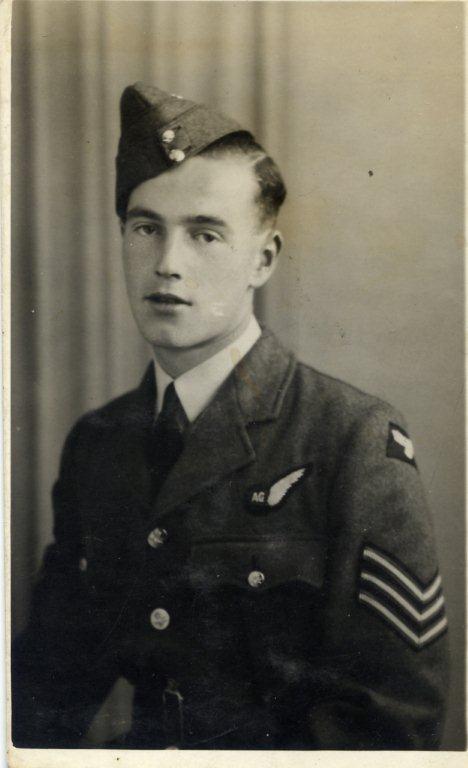
A very young Ron Wisson, and below one taken after the war.